Wolf Oven Repair
Wolf Serial Number Lookup: Finding the Year and the Series
To date a Wolf appliance, read its rating plate: some tags print the manufacture date next to the serial number, and Wolf publishes no key for decoding a year from the digits. Here is where the tag sits on each Wolf product and what else it reveals.
Written by Greg Lindqvist
Bench speciality: gas ignition and burners · Years at it: 18
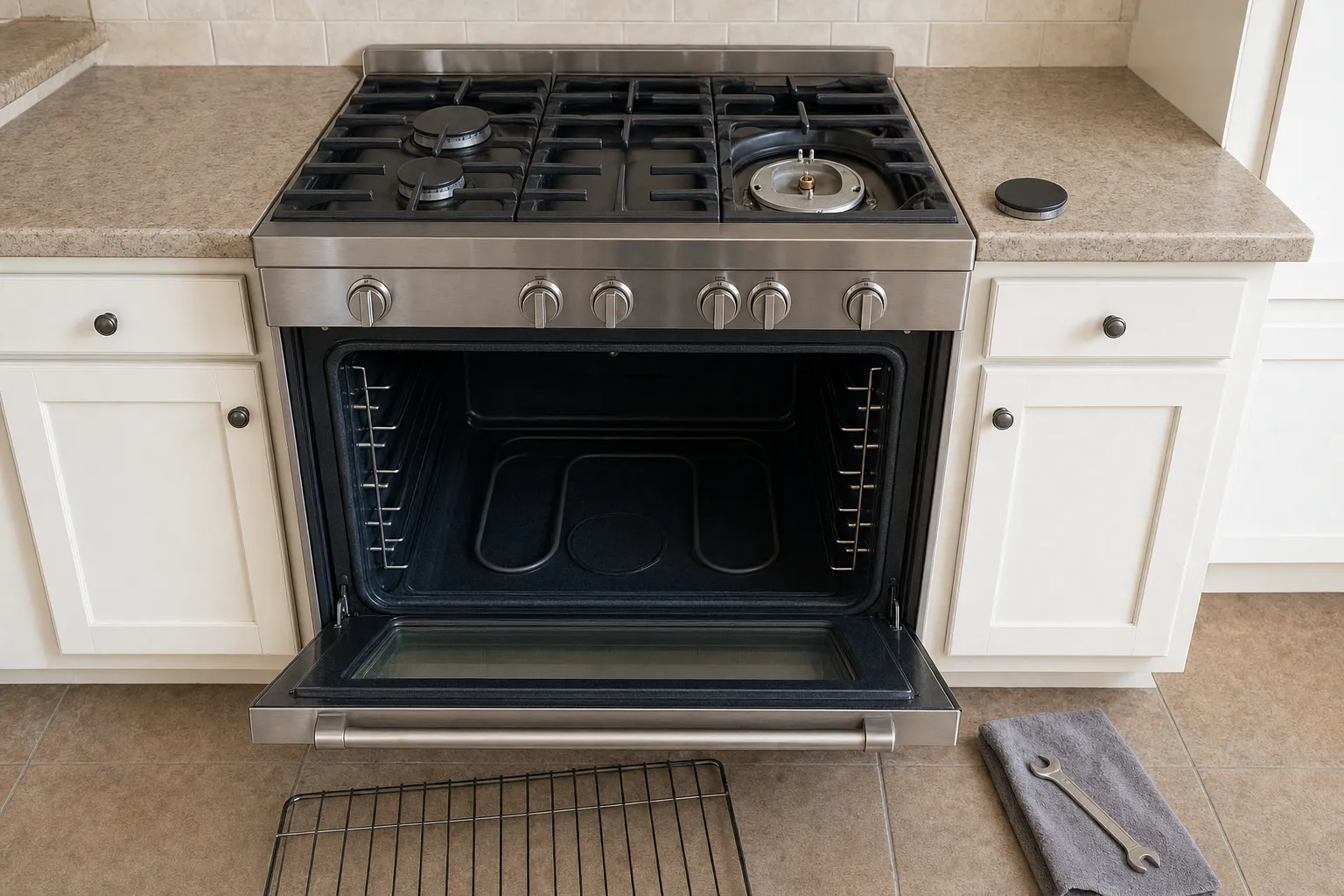
The year a Wolf was built is printed on its serial tag on some models, and that printed date is the only age you can read straight off the appliance. Wolf’s diagrams call this tag the rating plate; it carries the model number, the serial number and the total amps, and Wolf does not publish a key for turning the serial digits into a year. If your tag shows no date, use the installation paperwork, the warranty registration or a call to Wolf’s customer care with the serial number in hand. Built-in ranges and wall ovens stay behind when a house sells, so plenty of owners in Somerset and Bridle Trails inherit a Wolf with no invoice at all, and the tag becomes the one record that cannot go missing.
Where the tag sits on each Wolf product
Most people check the back or the sides and give up. Wolf puts the plate somewhere you can reach without pulling the unit out of the cabinetry, but you often have to open a door or lift a part first.
| Wolf product | Where to look |
|---|---|
| DF dual fuel, IR induction and GR gas ranges | Open the oven door; the plate is low on the control panel, at the right-hand end |
| SRT sealed burner rangetops | Low on the control panel, at the right-hand end |
| Older R Series ranges and RT Series rangetops | Lift the left surface burner pan; the plate is on the left wall of the burner box |
| SO3050/DO3050 wall ovens | Door open, by the bottom trim on the left side; on a double, use the lower oven |
| Convection steam and speed ovens | Left side of the front face frame |
| Cooktops | On the underside of the unit |
| Drawer microwaves | Floor of the cavity, behind the drawer |
| Warming drawers | Drawer open, front left of the cabinet floor |
| EC2450 and EC3050 coffee systems | Slide the machine forward; the plate is above the coffee compartment |
| OG outdoor gas grills | Behind the logo above the drip tray, so take the tray out first |
Two small notes. The cart under an OG grill has no serial number of its own, so there is nothing to hunt for there. And a cooktop plate is often easier to photograph from inside the base cabinet, with a flashlight and a phone held upside down, than to read by lifting the unit. Our page on finding the model number on a Wolf oven covers the oven side in more detail.
What the plate tells you besides the age
Hold on to the model number, because it says far more than the serial. It names the product family and, for wall ovens, the series, which settles the common M-versus-E question without guessing from handles or knob styles. It also fixes the burner load: a GR304 gas range is rated at 84,200 Btu in total, a GR366 at 114,200 and a GR488 at 162,200, figures a technician leans on when a burner seems weak or a hood seems overwhelmed. If ventilation is the real worry, our piece on why a Wolf rangetop is hard to vent picks that story up.
On a gas unit, the plate also states the fuel. NG or NAT means natural gas and LP means liquid propane, and a unit that has been converted should carry a second sticker near the original plate naming the new gas. Piped gas in Bellevue is natural gas, so a range in Crossroads or Downtown Bellevue whose plate reads LP, with no conversion sticker beside it, deserves a question before anyone works on the burners, because the orifices are sized for one fuel or the other.
Reading age from the serial without a date
If the plate carries no date, the number still works as a position in Wolf’s production run. Wolf’s own service documents use serial numbers as cut-off lines: pro ventilation hoods began shipping with grease cups and spacers starting at serial 16314782, so a hood below that number and one above it can need different parts even though they look identical from across the kitchen. That ordering lets a technician say whether one unit is earlier or later than another, but pinning it to an exact year still takes Wolf’s records.
The paper trail is the other route. Wolf asks owners to register products online or in its owner app, and a warranty claim needs the model and serial from the rating plate, the date the unit was installed and the name of the dealer. If you bought the house with the appliances in place, ask the sellers or their builder whether the range was registered; a registered unit already has its date on file.
Check the recall notice while the door is open
While the number is in front of you, compare it with Wolf’s recall on griddle-equipped dual fuel ranges. CPSC recall 25-034, issued November 7, 2024, covers Wolf Dual Fuel ranges with infrared griddles, such as the DF36450G/S/P, in serial ranges 18517201 through 18868311 and 10006001 through 10006009. The concern is that a spill can short-circuit the range and switch the griddle on by itself. If your plate falls inside either block, contact Wolf about the recall remedy before using the griddle again. The fact that one notice lists two unrelated blocks of numbers is also a good reminder that the serial is a production number, not a calendar.
Why we ask for both numbers before a visit
A Wolf part that fits one production run may not fit the next, so the serial is what lets parts be matched before the trip rather than after it. With the model and serial, the gas type and a short description of the fault, a technician can arrive with the right igniter or sensor instead of booking a second visit. Wolf Repair Bellevue is an independent service that is not affiliated with Wolf, and if your unit is still inside its warranty, the registration details above are what Wolf will ask you for first.
Finding the fault costs $89 for the visit, and if you give the go-ahead that $89 comes off the repair. Call (425) 629-0033 with the numbers from the plate and we can tell you what we expect to check.
When age changes the repair decision
Knowing the age matters most when the repair is a big one. Typical ranges run $170–$430 for an igniter or spark module, $200–$440 for an oven thermostat or sensor calibration, and $470–$890 for a control board or touch panel, with the firm price given after diagnosis. Set those against the price of a comparable new professional range and most repairs still make sense on an older unit, provided the parts are still made. That proviso bites hardest on the oldest ranges, which is why we keep notes on parts for older Wolf R Series ranges.
Common follow-ups
Can I work out the year of my Wolf from the serial number alone?
Usually not by yourself, because Wolf does not publish a key for reading a year out of its serial numbers. Look at the rating plate first, since some models print a manufacture date there, then fall back on your installation paperwork, the warranty registration or Wolf's customer care.
How do I tell whether my Wolf wall oven is M Series or E Series?
Read the model number on the serial tag, which identifies the series. On SO3050 and DO3050 ovens, open the door and look near the bottom trim on the left side; on a double oven the tag is in the lower cavity. Steam and speed ovens carry theirs on the left of the front frame.
Where is the serial number on a Wolf warming drawer or drawer microwave?
On a warming drawer, pull the drawer open and look at the front left of the cabinet floor. On a drawer microwave the tag sits on the floor of the cavity behind the drawer. Copy the model number from the same tag, since the serial alone is not enough to order parts.
Does the tag show whether my range runs on natural gas or propane?
Yes, the serial tag and rating plate on a Wolf gas product state the fuel, with NG or NAT for natural gas and LP for liquid propane. If the range was converted at some point, look for a separate sticker near the original tag naming the new gas type.
Why does the technician need the serial number and not just the model?
Because Wolf changes parts partway through a model's run and marks those changes by serial number. Pro ventilation hoods, for example, gained grease cups and spacers from serial 16314782 onward, and recall 25-034 is defined by serial ranges, so the serial decides which parts fit and whether a notice applies.