Oven models · E Series
Wolf DO30TE Lower Oven Cold, Upper Fine — Why?
DO30TE/S/TH 30-inch built-in double oven Built 2015–2020
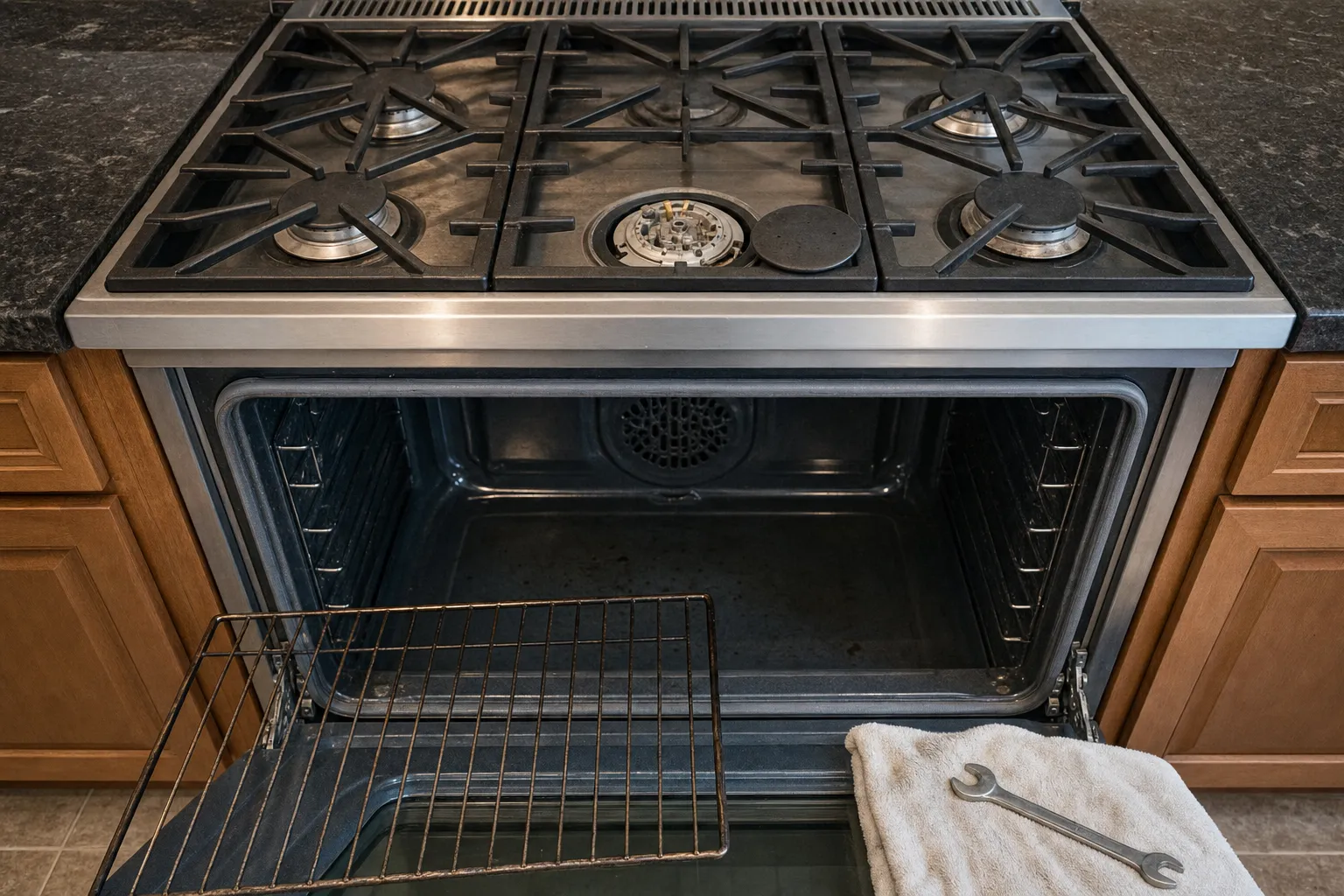
Wolf's DO30TE is the Transitional 30-inch double oven in the E Series, made from 2015 to 2020. When the bottom oven stays cold and the top one cooks normally, the fault usually sits inside the lower cavity. Wolf Repair Bellevue, (425) 629-0033, tests that cavity on the $89 visit and quotes the part before ordering it.
- Written and checked by
- Imogen Fairhurst
- Dated
- Bench speciality
- ovens and calibration
- Years at it
- 12
- Control panel and board
- Cooling-air path behind the panel
- Broil element
- Temperature sensor
- Convection fan (upper oven; lower varies)
- Bake element (often hidden below the floor)
- Door gasket
- Self-clean door lock
- Door hinges
What fails on it
- Lower bake element The cavity barely warms in bake modes. Elements have no set band on this site and are quoted after the diagnosis.
- Lower-oven sensor It warms up, but lags well behind the display or overshoots it, while the upper oven stays accurate.
- Lower door seal A worn gasket on the bottom door lets heat bleed away, so that oven is slow to come up and sags during a long bake.
- Convection fan below Convection bakes in the lower oven turn patchy, and its fan stays silent after preheat with a convection mode set.
- Wiring to one cavity Less often, a connection feeding the lower oven alone has failed. Traced by the technician, never by opening panels yourself.
One cavity, its own parts
Each oven in a DO30TE heats with its own elements and reads its own sensor, so one can fail while its partner carries on as usual. The parts the two share, the control and the power supply, tend to show up as trouble in both ovens at once, or as a display that misbehaves.
What the visit checks, lower oven first
The bottom oven is heated and measured against a probe. Next, each of its elements is checked for heat, and its fan is run on a convection mode. If all of that passes, the connections serving that cavity are traced. You get one quote once the failed part is known, and the working upper oven stays available to you meanwhile.
Common questions
- How do I check that only the lower oven is at fault?
- Run the lower oven on its own in a plain bake mode with the upper one off, let it finish preheating, and read a separate thermometer on its middle rack. Then do the same with the upper oven. Jot down what each showed; it shortens the visit and points the testing at the right cavity.
- Why does an element have no price band here?
- This site publishes bands only for the repairs it prices in advance, and bake and broil elements are not among them. Once the $89 diagnosis confirms which element failed, Wolf Repair Bellevue, (425) 629-0033, gives you one figure for the part and the labor before anything is ordered.
- Could it be the breaker?
- Worth a glance if the whole appliance is dead. When the top oven works, though, power is plainly reaching the DO30TE, so the fault is more likely inside the lower cavity than at your electrical panel. Please do not remove access panels to look further; that part belongs to the visit.