Wolf Range Repair
Wolf Burner Clicks But Will Not Light: What It Usually Is
A Wolf burner that sparks endlessly without catching is nearly always a soaked electrode, a misplaced cap or a tired spark module — here is how to tell which one before you call anyone.
Written by Greg Lindqvist
Bench speciality: gas ignition and burners · Years at it: 18
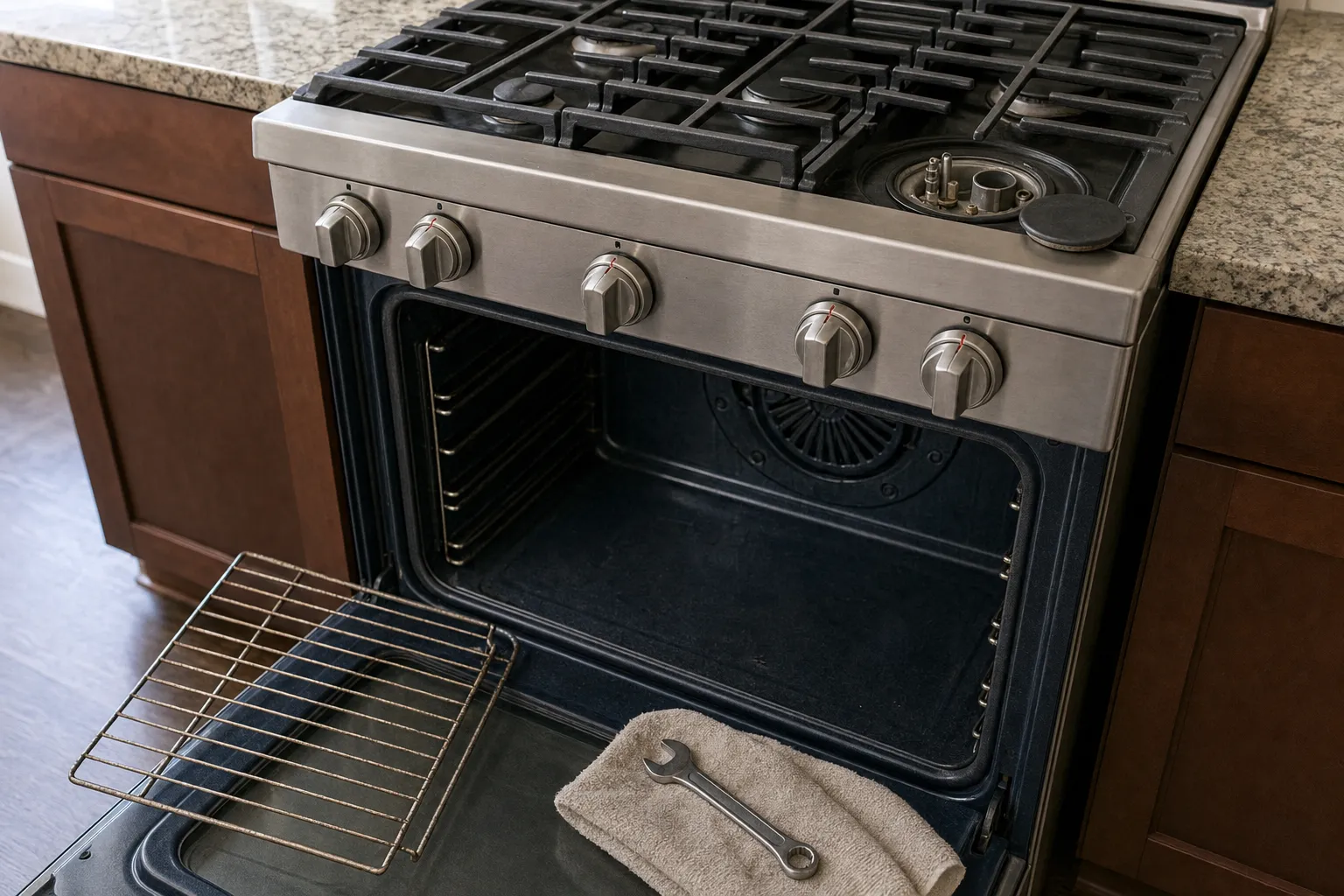
A Wolf burner that clicks and clicks without lighting is the single most common call we take in Bellevue. It is also one of the least alarming: in the overwhelming majority of cases the gas supply, the valve and the burner itself are all fine, and the fault sits in the small ignition circuit that turns spark into flame. Knowing which of four things it is takes about five minutes at the cooktop.
Before anything else, turn the knob off and let the range sit for a minute. Repeated failed ignition attempts pool unburned gas under the cooktop, and the useful diagnostic steps below all want a burner that is cold, dry and not fuming.
What the clicking is actually telling you
The clicking is the spark module doing its job. When you push and turn a knob into the ignite position, a switch closes and the module starts firing high voltage at the electrode — the small white ceramic pin sitting beside the burner head. That spark has to jump a precise gap to the metal burner cap, and it has to jump it through gas rather than through a puddle or a crumb.
So a clicking burner has already told you two useful things. Power is reaching the module, and the switch behind that knob is working. What has not been confirmed is that gas is arriving, that the spark is landing where it should, and that the burner cap is seated the way the factory left it.
If no burner on the cooktop clicks at all, the problem is upstream — the module itself, its power supply, or the harness. If more than one burner clicks when you turn a single knob, note which ones and mention it when you call: it changes where the search starts, and it is not something to diagnose from the floor.
The four faults behind almost every case
A wet or dirty electrode. This is far and away the most common cause, and the most common trigger is a boilover. Sugar syrup, pasta water or a spill that has run into the burner well leaves a conductive film across the ceramic. The spark then tracks down the film to the nearest metal instead of jumping the gap, which you often see as a spark firing at the base of the electrode rather than the tip. A burner that worked perfectly until the night someone boiled over on it is this fault until proven otherwise.
A misaligned burner cap. Wolf caps sit on a locating ring and only work in one orientation. Lift the cap, check for a slot or notch, and set it back down flat. A cap that is high on one side by a millimetre or two moves the spark gap enough to kill ignition, and caps get knocked when pans are dragged across the grates. If the burner lights instantly after you reseat the cap, you are done.
Blocked burner ports. The ring of small holes around the burner head can silt up with grease and carbon, especially at the port nearest the electrode. When that particular port is blocked, gas never reaches the spark even though the rest of the burner is fed. The tell is a burner that eventually lights with a soft thump after several seconds, then runs with a gap in the flame ring.
A failing spark module. Modules lose outputs one at a time. If a single burner clicks weakly, irregularly, or at a slower rhythm than the others, and its electrode is clean and dry, the module is the likely candidate. This is a part replacement, not a repair, and it is worth confirming properly before ordering.
What to check yourself, in order
Give the burner ten minutes to dry after a spill before you assume anything. Then:
- Lift the cap and the head. They come off by hand on most Wolf sealed burners. Look for standing liquid in the well and for food debris around the electrode.
- Dry everything. A hair dryer on cool, or simply an hour of air, clears the film that shorts the spark. Wipe the ceramic with a cotton swab and rubbing alcohol, then let it flash off completely.
- Clear the ports. A straightened paper clip or a stiff bristle brush. Never a drill bit, a needle or anything that can widen a port — the port sizes are part of how the burner meters gas.
- Reseat the cap squarely on its locating feature and confirm it does not rock.
- Try again, once. If it lights, run it for a minute at high and then at simmer to confirm the flame ring is complete and even.
If that fixes it, the repair cost you nothing. A good share of the burner calls we take in Bellevue turn out to be solved by exactly those five steps.
When it stops being a cleaning problem
Call someone if any of the following is true. You smell gas around the range with every knob in the off position — that is a valve or a fitting, and it is the one symptom on this page that should not wait. The electrode is cracked, or the ceramic is chipped or blackened along its length. The clicking is weak, uneven or absent on one burner while the others sound crisp. The burner lights but will not hold a low simmer, which points at the valve rather than the ignition. Or the burner lights with a delayed whump instead of an immediate pop, which means gas is accumulating before ignition and the timing needs correcting properly.
A cracked electrode or a dead module output is a parts-level repair — usually under an hour once the fault is confirmed and the right part is in hand. What makes it worth a professional is not the difficulty of the swap; it is that the correct diagnosis stops you replacing a perfectly good module because the real fault was a two-dollar cap sitting a millimetre proud.
Common follow-ups
Can I carry on cooking on the other burners while one of them keeps clicking?
The other burners are fine to use, but stop trying to light the faulty one. Every failed attempt releases unburned gas into the room, and a burner that finally catches after ten seconds of gas flow can light with a bang rather than a pop.
Why does the clicking sometimes carry on after a burner has lit?
The clicking normally stops once the burner is alight and the knob has come back out of the spark position. Clicking that carries on over a lit burner usually means the electrode beside it is wet, dirty or sitting out of line with its cap, and drying and reseating that burner is the first thing to try.
Can I clean the electrode myself?
Yes, with the gas off and the burner cold. A dry toothbrush and a cotton swab with rubbing alcohol on the ceramic is safe. What is not safe is scraping the ceramic with anything metal or bending the electrode to move it closer to the cap.
How much does this usually run?
An electrode or a cap replacement is a low-cost parts job. A spark module is more, but it is still a fraction of a cooktop replacement, and either is a short repair once the right part is in hand. The figure comes after the $89 diagnosis, and you agree it before anything is ordered.